29 June - 9 October 2011
Exhibition
Offenes Depot #1: The Empty Plan
Staatsgalerie Stuttgart
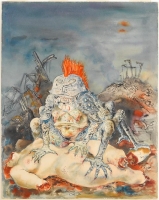
With works by Honoré Daumier, Rudolf Dischinger, Otto Dix, Albrecht Dürer, Daniel Chodowiecki, Conrad Felixmüller, George Grosz, Lea Grundig, Karl Hubbuch, Fernand Léger, Adolf Menzel, Iwan Puni Alfred Rethel and Rudolf Schlichter selected from the depot of the Staatsgalerie Stuttgart by Blaise Kirschner and David Panos with the art historian Kerstin Stakemeier and presented in conjunction with their film The Empty Plan (2010), curated by Alice Koegel.
In their selection of works from the depot, above all from the Prints and Drawings Department of the Staatsgalerie Stuttgart, Kirschner and Panos explore the complex and changing relationships between artistic forms and political movements in the crisis period before the Second World War. The starting point is Brecht's critique of naturalism and nationalistic constructions of realism, which gained popularity in that period and were also present in the exhibition programme of the Graphische Sammlung. In his theoretical as well as practical work, Brecht instead defined realism as a critical attitude towards prevailing conditions in relation to possibilities of collective change. The selection of works from the Staatsgalerie Stuttgart was made in dialogue with art historian Kerstin Stakemeier and draws on her extensive research on the subject of realism.
Today, raising the question of how to define the concept of Realism in art is a statement in itself, given that Realism tends to be framed either as a nostalgic emblem of an idealised revolutionary past or as an academically pacified version of a once active discourse. The opening up of historical materials and narrations you chose in your film [The Empty Plan], and which we tried to extend in the conjunction of artworks with press clippings and textual fragments of the period, boycotts such limited perceptions of the relation between art and politics. I would propose that there are two value judgements which art history deploys to restrain an understanding of historical material: these are the questions “was it good art?” and »is it good art now?« Both have to be substituted by what Walter Benjamin described as ›actualization‹ – a process which opens up the past in recognising it as a part of the present, forming a lever to emanicapte both. KERSTIN STAKEMEIER
The Empty Plan - exhibition publication (Koegel, Stakemeier, Kirschner & Panos, 2011) from Offenes Depot: The Empty Plan, edited by Alice Koegel, Staatsgalerie Stuttgart, 2011.