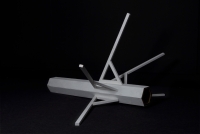
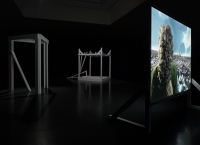
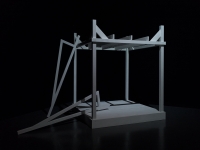
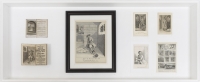
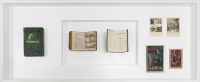
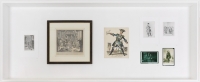
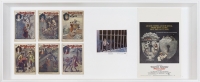
The Last Days of Jack Sheppard (Blaise Kirschner and David Panos, 2009)
HDV, 56min, sound
Set in the wake of Britain’s first financial crisis, the South Sea Bubble of 1720, and based on the inferred prison encounters between the infamous thief Jack Sheppard and the writer Daniel Defoe, this critical costume drama traces connections between capital punishment, fiction, speculation and aesthetics.
16 November 1724, Tyburn, London
Jack Sheppard, a carpenter’s apprentice turned thief, who achieved unprecedented celebrity through his frequent and skillfull prison escapes, is about to be hanged on the gallows. A third of the city’s population has come to watch the execution and now finds itself listening to Sheppard himself, who uses his last breath to advertise his supposed autobiographical Narrative, handing it to it’s publisher, Applebee, in plain sight of all, before being ‘turned off’.
As Benedict Seymour observes in his Notes on The Last Days of Jack Sheppard: “There is something rather ‘aesthetic’ about this final instant, then. To quote one of the newspapers of the day, Sheppard was hung up and ‘dangled in the Sheriff’s picture frame’ for 15 minutes. ‘The sheriff’s picture frame’ makes clear the tacit connections between artistic and literary representation and the State’s repressive apparatus. Beyond any Warholian undertones, the link between execution and celebrity is not just via the struggles over the body of the malefactor, the crowd’s identification with the victim or the ballad sellers’ narration of their life and times. In fact, the gallows are aesthetic insofar as it constitutes a crude means for communicating a message to those that can read Jack’s broken body.”
Who is the readership of the body, who of the Narrative?
Commissioned and produced by Chisenhale Gallery, London, and CCA, Glasgow, with the support of the Henry Moore Foundation, Arts Council England and the Scottish Arts Council.